

Many politicians, from both parties, say that our education system should prepare all students for successful careers. It’s a great goal. But the devil’s really in the details. What programs could states actually afford to offer to all students? How would that work?
The first step to scaling career pathways is realizing that there is no single "best" program model. Rather, each model represents a different tradeoff between scale and specialization. State policymakers need to create a mix of different models that maximizes the benefits of each.
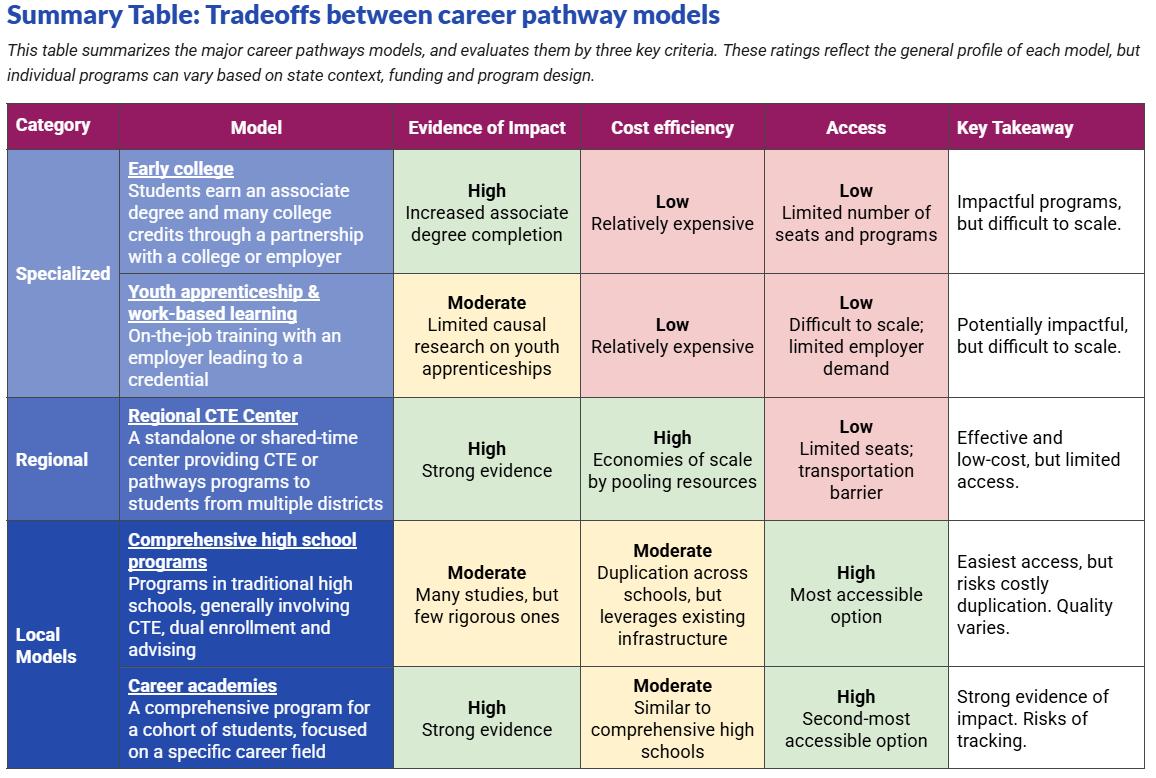
In “From Inertia to Intention,” the latest brief in our Pathways Policies That Work series, my coauthor Quentin Suffren and I provide practical advice for state leaders about career pathways models.
We have three recommendations:
Rec. #1. Create a pyramid of models
Organize your state's pathways programs into three tiers of decreasing size: most students should be in local programs in their high schools, many students should be in regional centers, and some students should be in specialized programs like apprenticeships.
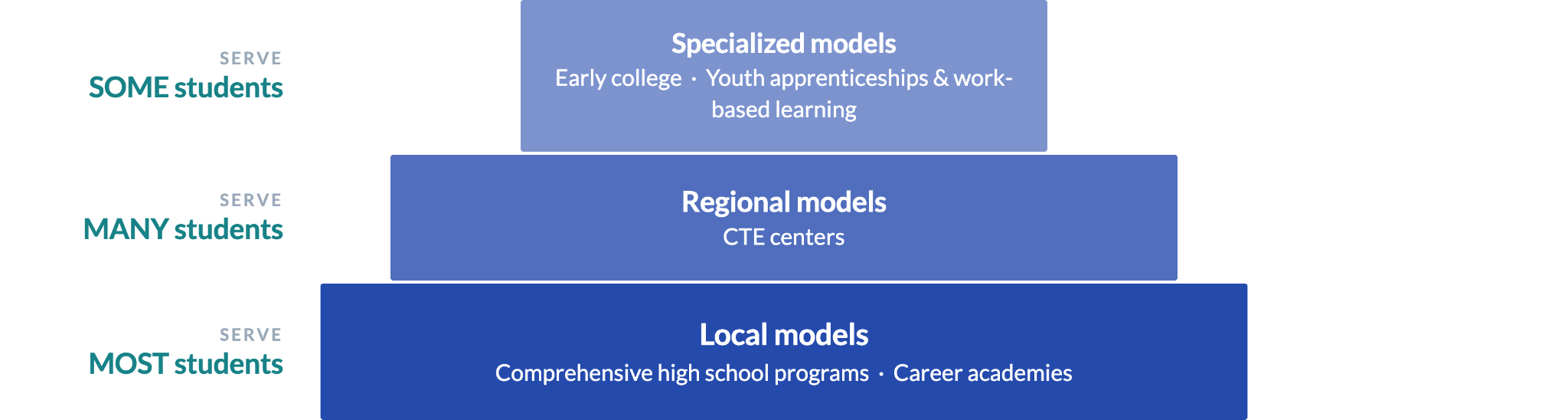
Don’t try to scale the specialized programs to everyone; use local programs for that. (Yes, it’d be great if every student in your state did an apprenticeship, but that’s never gonna happen—and you’ll waste a lot of money trying.)
Policy recommendations:
Seed specialized models (the top): Grow high-impact, specialized programs (like apprenticeships and P-TECH) for a small subset of students. Do not try to scale these programs to all students; local models are more cost-effective for that purpose.
Build out regional models (the middle): Centralize high-cost, hard-to-staff programs in regional centers. This creates economies of scale. Provide designated funding for the capital and equipment costs for these centers, and identify high-priority career fields.
Strengthen local models (the base): Convert disjointed high school programs into integrated pathways by setting clear quality standards. Scale career academies by creating statewide contracts with vetted implementation partners.
Rec. #2. Set a high floor for all models
Career pathways research points to one consistent lesson: depth beats breadth. The value of a pathway comes from following an integrated program, completing higher-level courses and earning a credential. States should hold every pathway, regardless of model, to the same high standards for quality.
Policy recommendations:
Require all models to integrate all elements of a high-quality pathway: As a precondition for funding, require all models to create a program of study that connects advising, CTE & dual enrollment sequences, work-based learning and an opportunity to earn a credential of value. (See our Commission on Purposeful Pathways report for more.)
Measure completion, not just participation: Ensure programs are genuinely delivering value to students by shifting incentives from participation to program completion. Use performance-based funding and outcomes reporting to achieve this.
Build employer-engagement infrastructure: Create the connective tissue between employers and schools, such as regional intermediaries funded through payroll taxes, to expand work-based learning opportunities for students.
Provide technical assistance: Fund state-level support for smaller and rural districts to navigate pathway development, ensuring these regions have the capacity to build and maintain high-quality programs.
#3. Focus on the ends, not the means
In an ideal world, states would take no position on models at all: they would fund outcomes and let effective models grow while weak ones shrink. The problem is timing. Career pathway outcomes take years to become apparent, so focusing on outcomes alone is like driving by looking through the rearview mirror: you are stuck looking backward at where you have been, not what’s in front of you. The fix to this “Rearview Mirror Problem” is to use both mirror and windshield: look retrospectively at prior outcomes and make educated hypotheses about which models are likely to work in the future.
Policy recommendations:
Incentivize evidence-based models, and seek more evidence: Prioritize proven, evidence-based career pathways models while carefully supporting promising new approaches with built-in evaluation requirements.
Offer performance-based funding and make program approval model-neutral: Shift to model-neutral, performance-based funding that ties program support to specific, rigorous student outcomes—such as credential attainment and job placement—rather than facility or staffing requirements.
Sunset underperformers: Retire programs that fail to meet outcome benchmarks. Provide transition support to ensure that resources are consistently directed toward effective pathway models.
Allow interdistrict enrollment: Enable students to enroll in pathways programs across district lines, creating competition that incentivizes districts to improve program quality to retain students and funding.
Read the Full Brief
Read the brief to see how state leaders can move from inertia to intentional design in career pathways policy. The link below contains the full brief and a short executive summary.
This brief was generously sponsored by Jeremy Avins of Arnold Ventures. Dave Powell and Olivia Kelly provided editing and research support. Jeremy Avins and Shaun Dougherty provided helpful feedback.